Friday, May 4, 2018

Levoca and around


Friday, May 4, 2018


Up first for us today was Levoca, whose old town is still surrounded by its medieval walls.  We parked (illegally??) along the main square and arrived at its main attraction, the Church of St. Jacob (James) just as it was being unlocked for a tour (in Slovak).  The guide provided us with an English explanation of the interior’s highlights, most notably the world’s tallest Gothic altarpiece; at over 61 feet, it grazes the arch of the ceiling above.   A wooden sculpture, carved without nails, its representations of the Last Supper, Madonna and Child, the lives of James and John, and other hovering angels and saints glow with gold leaf.  There are numerous other altars and some lovely frescoes in the church as well.

Leaving the church, we walked along the old town walls and were able to see the pilgrimage church dedicated to Mary on the green hill above town.


Back in the square, we enjoyed seeing the variety of facades on the old merchants’ homes, the Town Hall’s interesting roofline, and the Cage of Shame, a decorated box of iron bars used for public punishment of miscreants and “women who went into the streets at night, unaccompanied by their men!”


Rather than take the pilgrims’ footpath up the hill, we drove, and were treated to a fine view of Levoca.  The red tile roofs of the old town, the spire of the church we’d just visited, and the encircling medieval walls were clearly visible.

A short distance from Levoca, the village of Spisske Podhradie is flanked by two notable sights.  We stopped first at Spisska Kapitula (Spis Chapter) a still-active 13th – century Catholic walled complex. For the second time today, we arrived just as a guide was unlocking the church for a tour.  We joined the group and wandered around the Cathedral of St. Martin on our own, as the Slovak explanation was lost on us.

Our next stop was at Spis Castle, which dominates the landscape for miles around from the top of a hill.  Actually, the castle’s almost 10 acres are too much for the hilltop; the complex spills down the hill, with walls encircling it all.  Our initial approach to the castle was somewhat daunting, especially given this afternoon’s warm weather.  The directions from the center of town took us to a parking lot at the very bottom of a steep, treeless path up to the lowest point of the castle’s walls.  The lovely parking lot attendant suggested that we might want to go to another parking area, higher up the hill.  Despite the fact that she spoke no English, her gestures were enough to get us to a much better position.  (We’d read about the better approach and tried to locate it on our own and at the local TI, where we were told that we would, indeed, have to use the “park and climb” lot!)  Even so, once we did park, we still had a bit of a hike uphill (no valet parking at the portcullis!), but it was a much better option.  The castle complex dates from the 12th century and has served not only as defensive fortifications, but also as palaces for rulers and the aristocracy.  We used audioguides to guide us around and through the many levels, rooms, and buildings of the castle ruins and their explanations helped us understand what we were seeing.


As if Spisske Podhradie’s two UNESCO-listed attractions were not enough, it has another claim to fame.  It has four Sister Cities and two of them, Show Low and Pinetop-Lakeside are in Arizona!  What are the chances – especially since I don’t think either of those places have ever been referred to as cities before?!?  In any case, Tom insists that this little factoid is blogworthy and knows how interested you all are!

En route back to our digs in Poprad, we stopped to see the oldest part of this town, Spisska Sobota.  We walked down the narrow tree-lined square, which is bordered by 16th- century buildings that were once the homes of merchants and artisans.

With that, we beat the rain and a bit of thunder to arrive back for happy hour and to pack our bags for tomorrow’s departure for Bratislava.

Thursday, May 3, 2018

In the High Tatras


Thursday, May 3, 2018


After a stop at the TI in Poprad -- just a short walk down the square from our apartment -- and armed with a selection of their maps and brochures, we were on our way to some of the villages situated midway up the slopes of the looming Tatras Mountains. 

Stary Smokovec is less than ten miles outside of Poprad and the drive along fields of bright yellow rape seed flowers toward the mountains was lovely.  We left our car in the village and took the funicular a short distance up the mountain to an area where numerous hiking trails begin.  We chose one and spent the better part of the day (along with lots of others) making an up and down circuit through forests, along swiftly running brooks and in view of thundering waterfalls. 

After returning to our point of origin, we opted to walk back down to Stary Smokovec, rather than returning on the funicular.  
It had been warm on the trail, and we were happy to get back to the car and head to our next destination on four wheels.  We took a road that connects several of the mountainside villages to Strbske (yes, that’s a word) Pleso and then headed down the mountain.

We arrived in Kezmarok in time to have a quick look at its small castle – now a museum – before closing time.  We walked a bit along the main street of the old town before deciding it was time to call it a day; we knew we’d walked whatever the requisite number of steps might be.

Tomorrow, we’ll reset the pedometers!

Wednesday, May 2, 2018

From Hungary to Slovakia


Wednesday, May 2, 2018

It was a short jaunt from Eger in northern Hungary into Slovakia this morning.  Our first stop was, of course, along the highway to purchase a vignette to satisfy the tolls on Slovakian roads.

Soon after, we arrived in Kosice to spend a little time exploring the area around its central square.  The square is actually a large and beautifully landscaped oval.  The dominant feature is the Cathedral of St. Elizabeth, Europe’s easternmost Gothic cathedral, which is sited within the oval.  While the exterior is dark and somewhat sober looking, vibrant stained glass windows make the soaring interior a luminous space.


Also within the confines of the large “square” are the smaller St. Michael Chapel, underground archeological excavations, the State Theater, several large fountains, and the Plague Column, erected  in gratitude to the Blessed Mother in 1723 for survival after wars and the plague.  Bordering this central space are other churches, shops, galleries, and restaurants – all housed in historic buildings.

Our next stop was in Bardejov, a UNESCO World Heritage site.  The wall of this medieval city still stand and its central square is large, bordered with individually decorated pastel buildings, originally homes of the merchant class.  The center of the square is a huge cobble-stoned space, largely empty, except for the Basilica of St. Egidius and the Old City Hall.


Bardejov is surrounded by a number of historic wooden churches, set in tiny hamlets among rolling hills in beautiful green countryside.  Nine of the churches, built between the 16th and 18th centuries, have been inscribed in the UNESCO World Heritage list.  They were built without nails and represent a mix of Roman Catholic, Greek Orthodox, and Protestant religious traditions.  Following quiet roads through a series of small villages we made our way to two of the churches, at Fricka and Krive, to have a look around.  (They’re closed most of the time, so we were not able to see either interior.)


Our home for three nights is in a modern apartment in Poprad, a city at the foot of the High Tatras Mountains.  From here, we expect to explore a bit of the mountains, a national park a castle and an historic town or two.  We’ll see what tomorrow brings!

Tuesday, May 1, 2018

Eger and Beyond


Tuesday, May 1, 2018

We spent the morning following a self-guided walking tour brochure through Eger’s historic center, beginning with the 19th-century Basilica, Hungary’s second-largest church.  Its massive presence is accentuated by its position up a long flight of stairs from a lovely square and the large statuary adorning its exterior. 


At the foot of the stairs and across the square is the Lyceum, a university founded in the 18th century as a teachers’ college when the emperor forbade the Archbishop from starting a university.  In response, Archbishop Charles Esterhazy built the most impressive teachers’ college in the world.  The only things the May Day holiday prevented us from seeing today were at the Lyceum – its baroque library and the Camera Obscura housed in its astronomical tower.  Next time…


Speaking of this holiday – Europe’s Labor Day – it’s taken very seriously.  We’ve gotten State Department alerts about workers’ demonstrations planned for today on cities along our route and pretty much all the stores are closed in Hungary today.  Even the biggest multinational superstores are shuttered – a significant difference from the way retailers in the US observe national holidays.


 Now, back to the sights of Eger…

We stopped into the Archbishop’s Park, a green leafy space with a variety of recreational and sporting options; we just enjoyed a shady brook-side bench!

Next to the park, we peeked into the thermal baths (Hungary is full of such facilities) and then headed to Dobo Square, where we’d had dinner last night.  The food, wine and beer stands were back in operation as we stopped into the Minorite Church, dedicated to St. Anthony of Padua (we meet again!) and containing remains of St. Hedwig, Hungarian princess and Polish queen.  The Baroque church was built in the 18th century and sits adjacent to Eger’s Town Hall, overlooking the square’s statue of Istvan Dobo, who led the defense of the castle against a 40-day long siege by the Ottoman Turks in 1552. 


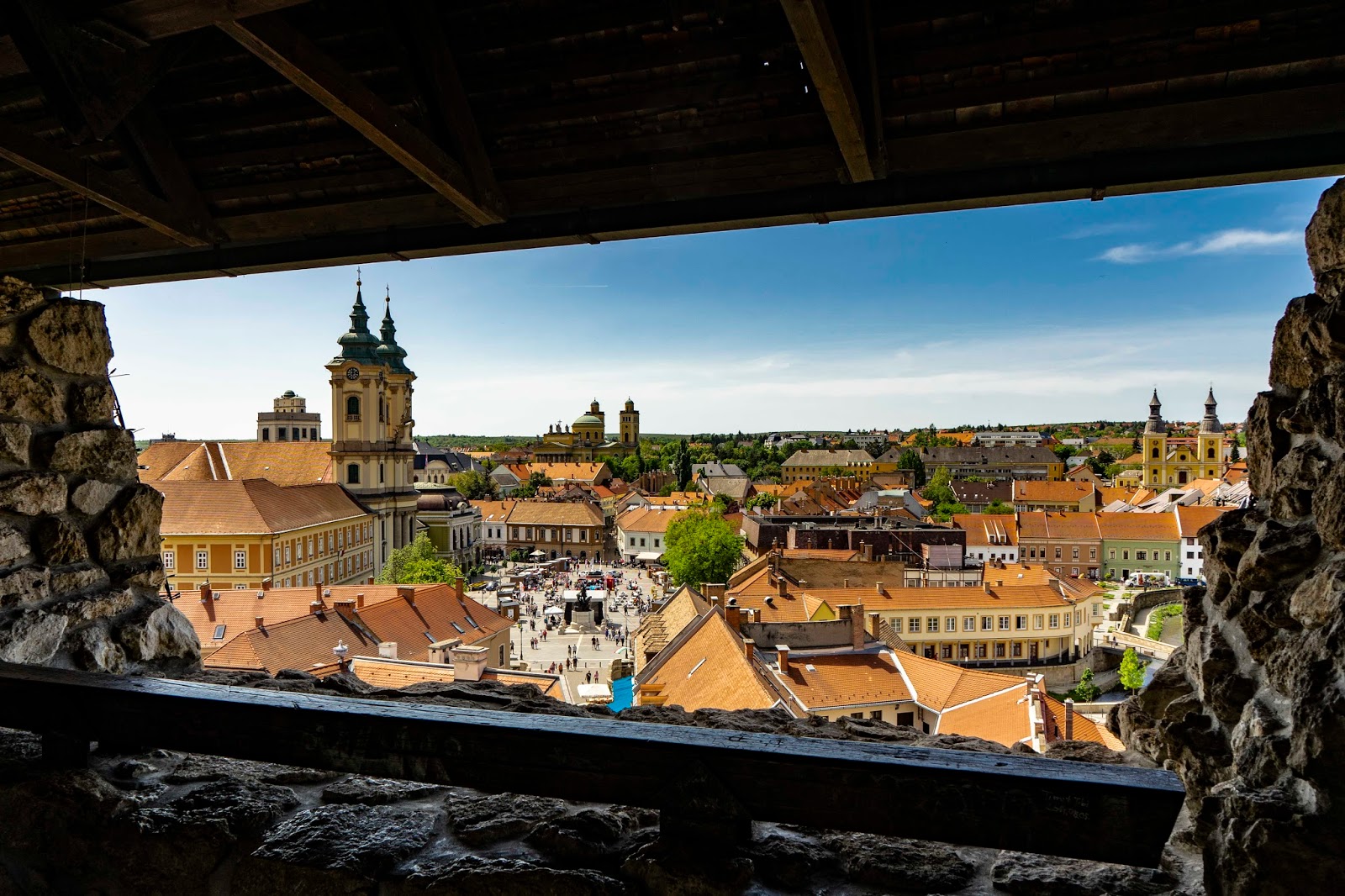
This, of course, led us to the castle itself, which was begun in the 13th century and made famous by the events of 1552; it is now a national memorial.  We wandered around and walked atop the castle’s walls, which overlook the town center, as well as the Minaret that was built by the occupying Ottoman Turks after they eventually overran and occupied the castle in 1596 and ruled the city for almost a century. 

The Minaret is the northernmost surviving Turkish structure in Europe from that period.  It is largely obscured now due to renovation work, but its traditional crescent -- now topped by a very untraditional cross – is visible.
Only Mel could resist a Mexican food truck in Eger, Hungary

After lunch and a cold brew at a shady table in the square, we returned to our apartment to pick up the car and head out of town to Szilvasvarad, the home of  Bukki National Park.   We rode a small train – uphill -- about 2 miles into the deeply forested park to see the area’s main attraction, a waterfall, which was lovely, but not impressive as waterfalls go.  We enjoyed a shady walk back on a paved (downhill!) path to our car and back to Eger for HH and dinner chez nous, or I should say, a házunkban.